
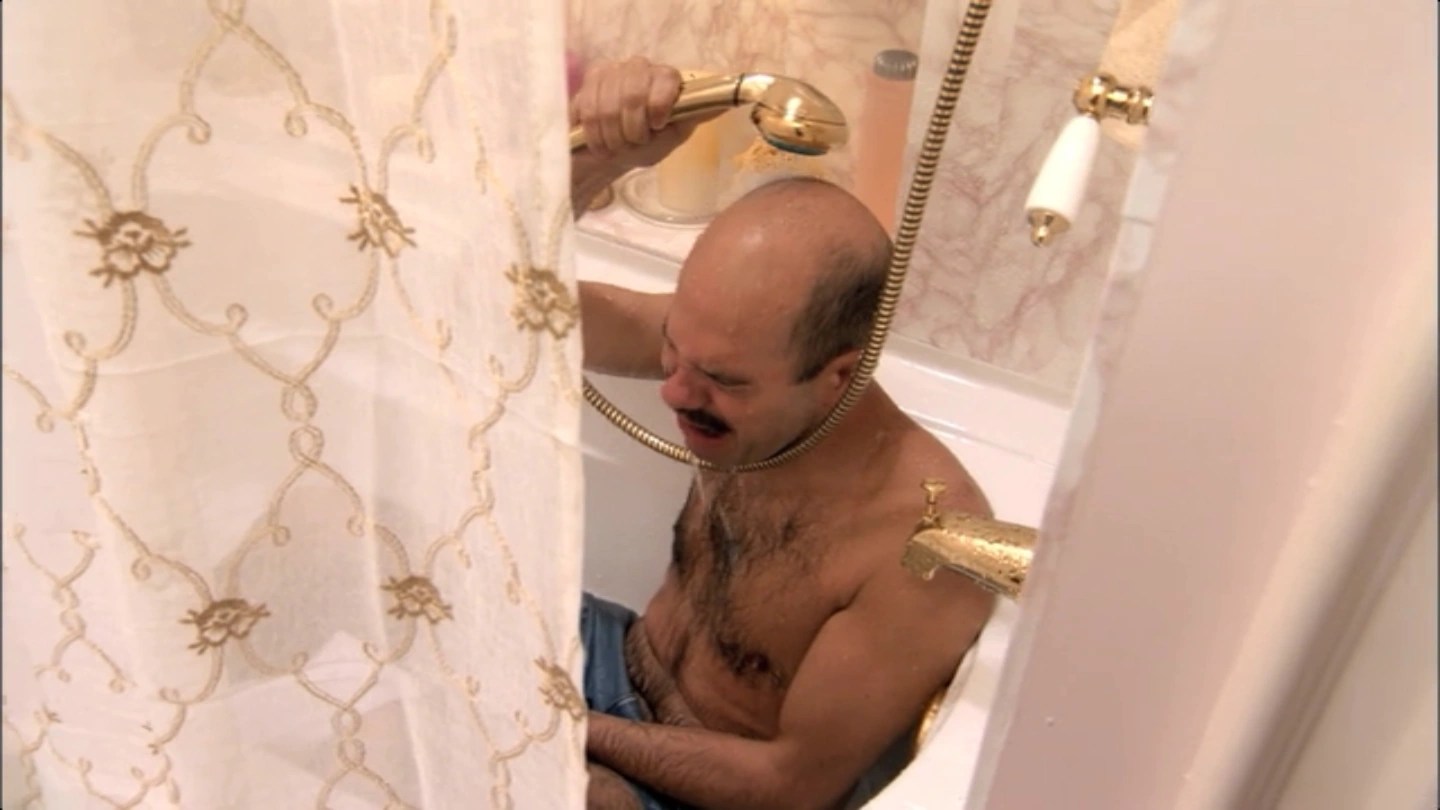
Occasionally, there are days where I just wake up and the first words that come out of my mouth as I stare at the ceiling are “god dammit”.
What I look like when I can’t fall asleep due to the memories
involved with beating the Water Temple from Ocarina of Time
The good news my friends: today is not one of those days. In a rare moment of committing to what we in the industry like to refer to as “a good fucking idea”, Konami stealth released the Castlevania: Dominus collection on August 27th, without any fanfare leading up to the titles launch day whatsoever. While this move has backfired in spectacular fashion in the gaming world in the past (See: The Sega Saturn launch), this circumstances surrounding the surprise release was met with nothing short of jubilation from both the gaming public and press alike, as we have been collectively waiting for the re-release of the DS trilogy of games for a long time.
The face of Castlevania fans the world
over when they heard the DS titles were
finally getting re-released
The reason Konami may have waited so long to let loose this collection of classic games is anyone’s guess, but I have a sneaking suspicion if you correlated the data of Konami’s success in the pachinko machine arena vs video game release schedule, you would see a not too surprising financial story of weary and woe, as Konami mostly gave up the ghost of having any value as a game company a long time ago. With the quality of the Dominus collection standing as the last time the Castlevania series was topical and relevant, see: 16 years ago, Castlevania may have represented the canary in the coalmine that not all was well in the land of Konami, as even outstanding titles like Dawn of Sorrow, Portrait of Ruin, and Order of Ecclesia weren’t even considered good enough to prevent the series from falling out of relevancy.
It would be like if the LOTR series fell into obscurity after the
movies released
I am only very slightly exaggerating in reference to the slow decline of the Konami gaming empire (in the West, at least) with that short synopsis, as the mix of their successful foray into the world of pachinko machines, combined with their complete lack of commitment in retaining talent circa 2010, while failing to maintain their big name gaming series is the stuff of nightmarish legend at this point. I will apologize after the fact at the complete lack of citation involving the history behind the collapse, as I don’t have much time right now so can’t be arsed to cobble together a hyperlinked timeline for you. One of the only reasons we likely even got the Dominus collection in our greasy little gaming hands was probably due in part to Nintendo and Netflix doing all of the heavy lifting and reminding people that Castlevania is still really fucking cool.
A Konami exec’s face while watching the Castlevania
anime on Netflix and thinking it would be an ideal
property to adapt to a video game series
I also wouldn’t be surprised if the Castlevania’s former series creative lead Koji Igarashi’s massive success with his kickstarted game Bloodstained, amongst the cornicopia of titles populating the metroidvania genre he helped to spawn, also helped to keep alive the spirit of the series he had to abandon, but I digress. This write up wasn’t suppose to be pissing on the memory of the failed and the fallen, but the first of a multipart retrospective involving the games in the Dominus collection. I chose to arbitrarily start with Portrait of Ruin, mostly due to the fact that I’ve played Dawn of Sorrow the most, and Order of Ecclesia is quite similar to what Bloodstained ended up being, so I feel as if I’ve spent the most time away from Portrait of Ruin, so let’s shoot the shit a little about what Portrait of Ruin has to offer.
Picture: slightly related
One of the more bizarre moments of interest with Portrait of Ruin was that based on how it was received overall upon release vs the other two DS titles that launched on the system, was that Portrait was more or less considered the lesser of the three. Don’t get me wrong, the game reviewed well and was placed on lists of acclaim left and right after launch, I think it’s more a telling dictation of just how strong the pedigree was for the DS titles across the board, with Dawn of Sorrow and Order of Ecclesia only making Portrait of Ruin pale in comparison to the level of quality they were bringing to the table.
Is Portrait of Ruin the Temple of Doom of the
Dominus Collection?
Building off of that point, I think that when you look at Dawn of Sorrow, the only detractions from people you ever really hear about the sequel are 1: the touch controls, and 2: the art direction. I think most people agree that while the DS certainly had it’s moments of innovation with utilizing the systems touch screens in a lot of amazing ways, the stuff they did with Dawn of Sorrow was needlessly tacked on bullshit to fill some ridiculous quota of showing off the systems capabilities. Whenever you change formula drastically enough to fundamentally upset the status quo enough that gamers start to turn against you as a result, you know yah dun goofed, which is essentially what happened with the touch screen based seal mechanic in Dawn of Sorrow.
They really sealed their fates with this
goofy gimmicky inclusion
The only other point of division for gamers with Dawn would be the people who lamented the lack of art done by infamous Castlevania illumni Ayami Kojima, who had helped to create some stellar art work for the series going all the way back to Symphony of the Night.
Dat Alucard, tho…
And as someone who pisses all over the idea of how derivative and bottom of the barrel crutching on basic anime stylization for one’s aesthetic can end up being, IGA’s decision to go that route to attract a younger demographic for the series based on the DS’ average age demographic was on point, as was thusly cemented way down the road after the fact.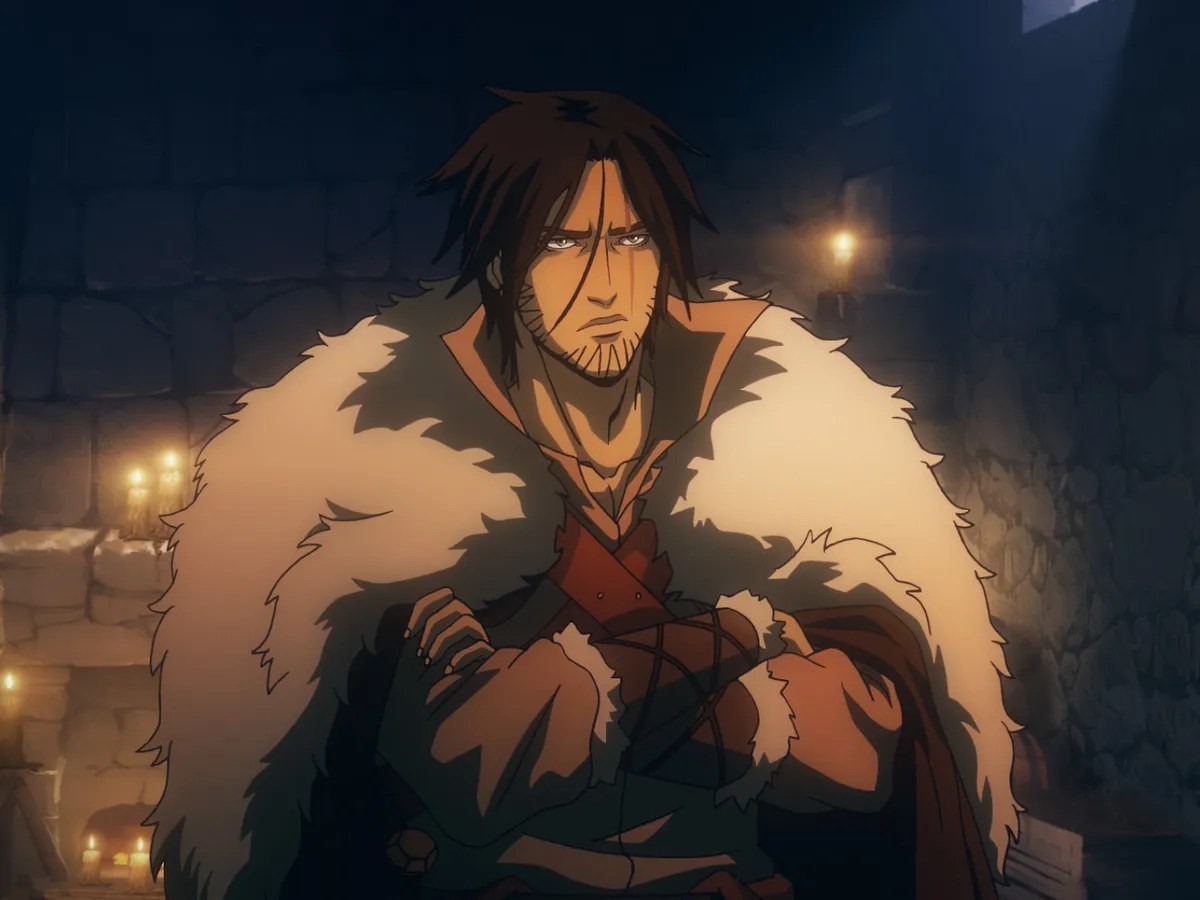
Pictured: Trevor Belmont grumpy he looks so fashionable
within an anime format
I guess to summarize my last few thoughts in a more succinct manner; with even the small points of contention involved with Dawn of Sorrow as a follow up to Aria, involves the game still being a follow up to Aria, which was just so damn good, it didn’t matter if the title took the low road with anime aesthetic or some clunky touch screen gimmicks: Aria was essentially nearly flawless as a spiritual follow up to Symphony of the Night, and likely the Castlevania game people had been waiting on impatiently for six years to finally get to play. No offense to the earlier GBA titles, and my condolences to the N64 “games” (it was really like one game and then a re-release with extra content), but Dawn of Sorrow was the sequel to the phantom that had haunted the series since gamers had finally and excitedly worked their way through the inverted castle.
For people who don’t know, the inverted castle was infamous
in that in order to beat it, you had to turn your tv upside down
in order to play it correctly (holds back laughter)
Which is why I ultimately think Portrait of Ruin wasn’t seen as the next grand ascension for the series, as gamers had already been recently treated to a double helping of what were arguably near ideal follow ups to Symphony in the form of the Sorrow duology. Not surprisingly, Ecclesia would go to course correct following Portrait, again, not because the title was considered bad by any metric, but because IGA and his team realized the way forward with the series after having been inspired by their own ideas in incorporating the portraits the way they did, to create a feeling of a more robust, expansive world Castlevania largely hadn’t seen up to that point, with the series usually being lock step with the equivalent of a bottle episode setting in video game format.
Hell of a piece of real estate
Whew, fun run down on some aspects involving my retrospective on the DS titles thus far, even though I ironically failed to discuss Portrait of Ruin at any great length. Something to look forward to for part two, I suppose. Stay tuned.
~Pashford
Tag Archives: old school
The Belmont’s Day Off: Long Weekend Edition
Filed under Active Time Event
30 Seconds of Fun
I’ve been talking about nostalgia recently, and it’s easy to understand why. When your hobby finally reaches more than 50+ years of relevant history, there is a lot to look back at all of the stunning quality involved with a respectful fondness.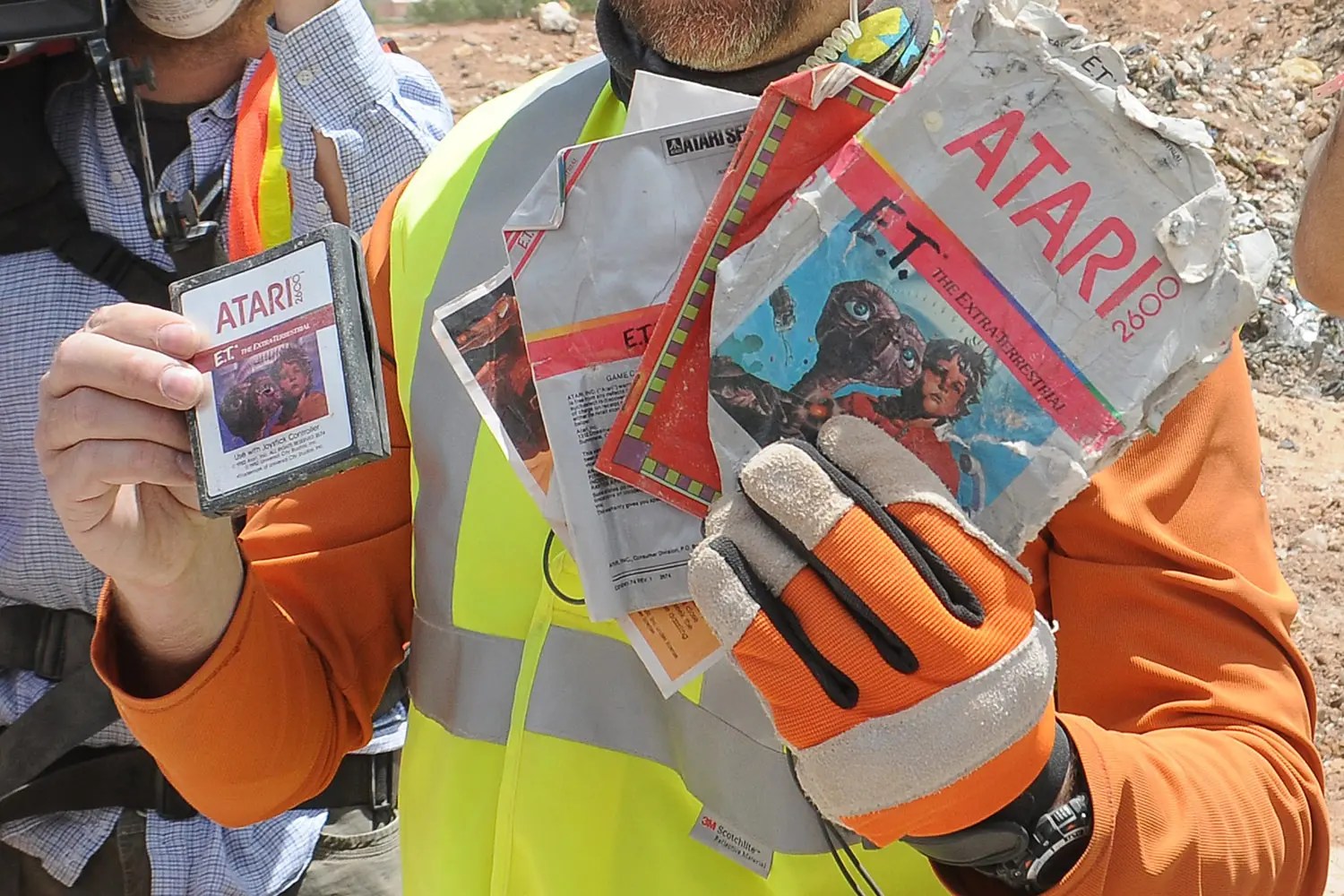
And sometimes not
With that in mind, once a year, I usually get a hankering to go back and play some old, old…old old school video games, and the hankering to play Yars’ Revenge hath returned. I decided to download Atari Flashback Classics Vol.1 to quell the desire, but also because I kind of needed something a bit short and sweet due to time constraints to discuss, and several decade old video games fit the bill.
Sic Parvis Magna
The classics collection series has been around in some form or another for awhile now, seeing both physical and digital releases over many years. They also had a run of plug-and-play related mini consoles that stored the dozens of games involved with any single iteration just to give it that real old school feel, Atari 2600 controllers included and all. This was well before Nintendo wanted in on the slice of the mini console retro pie with the release of the NES and SNES mini respectively. My point: in both their original forms and their re-released iterations, all of these games have been around for a hot minute.
Oozing forth from the halcyon era of the primordial soup
So one has a lot of games to choose from, even if many of them are extraordinarily simplistic and straight forward, and I cannot heavily emphasize enough of just how basic the games we are dealing with are. With Pong having been released all the way back in 72′ and working from there, to say these games are antiquated is an understatement. The severe technological limitations of the time demanded that the experiences were ridiculously compact, so often times a game would involve sometimes only a single screen encompassing the totality of all gameplay involved. 
Which did save a lot of time on gathering screenshots, mind you
You have to have a sense of humor about it, cause the whole thing is fucking silly when you really think about it for longer than two seconds. Don’t get me wrong: I do genuinely appreciate the gameplay involved with these classics, and the history that they represent, but you take a step back for a second and realize you’re dictating on a bunch of blocks on a screen with a high pitched buzzing sound from time to time and quantifying the creative endeavor or semantics of the game design therein. This write up will probably take more of your time than the average amount you’d spend playing any one of these games, in all of their adorable succinctness.

Behold! Basically all of the gameplay of Black Widow in a single pic!
Much to that point, there is a relevant quote I’m re-appropriating from a game designer named Jaime Griesemer, who worked on Halo 1 and 2 for Bungie back in the day. He famously described the process of designing a game as trying to nail that “30 seconds of fun”, massively paraphrase of course, going on to describe an average encounter in the Halo games he worked on. He would go on to point out that you can have great graphics and a cool story, but if you don’t nail that 30 seconds, you don’t have a game. (apologies for the lack of linked source; it happened, trust me.) Based on the caliber of design for both Halo titles in question, I would most certainly be inclined to agree. Retrofitting and applying that quotation within consideration to these old school Atari titles, the games represent such a distilled sense of concentrated gaming goodness, coupled with the limitations of the time, and you really are seeing that quote live up to it’s essence in real time, as any of these games really are that 30 seconds of fun and nothing else.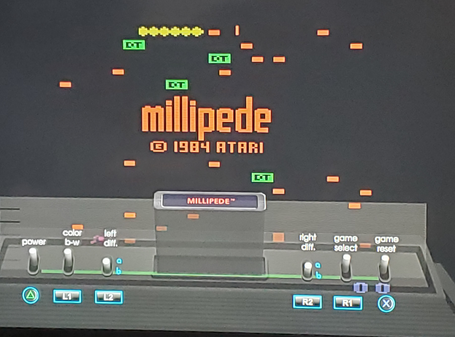
The replaybility on Millipede really has legs
And that’s perfectly alright, mind you, as these games had no frame of reference to work with, as their mission statement was to become the frame of reference for future generations to be inspired by. The onus back then was on giants like Atari to create the context for what would become the groundwork for the very foundation of gaming itself. Accomplishing that by spending time developing a title in a couple of months with almost no staff, a couple kilobytes of memory, and 30 seconds of fun to play around with, and you are left somewhere between shock and awe as you laugh at the absurdity of this very notion having spawned a multi-billion dollar industry that helped to make gamers of us all.
Yars’ Revenge: a real work of art
As is the case with a lot of my writing, I always have a billion ideas at the ready and only about 10 minutes to to do anything with them all. I’ll leave you with the reminder that Yars’ Revenge is awesome, and that in a stroke of ridiculous absurdity, a follow up sequel more than 40 years later (!) called Yars Rising, which is taking the form of a Metroidvania, is coming out for the Switch in a mere 23 days. And how!
~Pashford
Filed under Uncategorized
To Err is to Human, to Suck, Vampiric
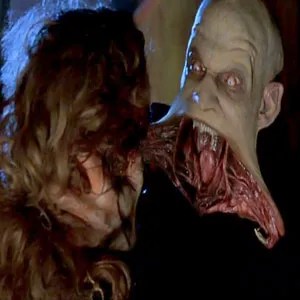
In spite of a positively excessive optimism involving my want to write with regular fervor and superbly matched candor, I have for lack of more elegant wording, sucked absolute dog shit in doing so.

To wit, I am back on the high horse of efficiency, which has been a matter of intense relevancy to me in the past involving producing interesting works. Or at least, horses are involved per say, no two neighs about it. Honestly, they are only tangentially related to the actual matter at hand, which is more about creatures of the night and what it is they actually do in the shadows.

Part of my efforts in pushing myself to write was downloading a new game to give me some fresh ideas with something juicy I could sink my teeth into. I think I must have been in the midst of a wild Castlevania kick, as I saw a title on the PSN called Wallachia: Reign of Dracula, and purely by my intensively honed in deductive reasoning skills, concluded it must be some Vania-esque knock off in which I could delight in. How much did Wallachia and Castlevania actually have in common?

The dissimilarities don’t detract from an experience to be enjoyed, mind you, they just bring into serious question my own value system in terms of judgement and expectation. What we have here in Wallachia is really more reminiscent of something ala Shinobi instead of the Retrovania series, in all of the series butthole clenching levels of platforming glory.

That is to say, Wallachia is more of a side scrolling hack and slash then a tough as nails action platformer, so just different speeds, really. So while I came for the bustle and hustle of Belmont boisterousness, I ended up rolling with the ninja like nonsense that followed suit. I mean, to that point, the game shares very little DNA with the Castlevania series at all, outside of sharing some lore and a villainous namesake the series has been ceremoniously lauded and proudly revered for doing all these long years…

In fact, I feel somewhat dickish in my attempts to discuss Wallachia, as it triggers within me the severe urge to gush about the Castlevania series with great gratuity, which may I remind you, has absolutely nothing to do with the game I’m attempting to discuss whatsoever.

Right. So Wallachia, which is definitely not Castlevania, is more of a side scrolling hack and slash…to an extent. The main character Elcin is billed in game as an excellent archer, as such, she has trained so much with her bow that not only is she a deadly shot, but she has also mastered the ability to carry approximately one trillion arrows at any given time. This comes into play nearly immediately and never stops, as you will basically be shooting them from your bow every second of every day till the heat death of the universe rolls around.

So run and gun may have been a more appropriate dubbing of the style of gameplay, as the combat is mostly ranged by virtue of said hyper-arching, which does actually give the game kind of a Contra flair a little more than Shinobi upon further reflection. With the notion of either game in mind or Wallachia representing some halfway house between the two styles, my mind reels regardless thinking about just how absolutely jacked Elcin would have to be to pull back the drawstring on that bow so often and so quickly.

Elcin’s absurdist protein regime is your gain, as it makes the flow of the fun feel pleasantly rapid fire. Since the title itself is in the vein of an old arcade romp, the levels feel reasonably brisk but always intense. Perhaps another point for house Shinobi as opposed to house Contra, as the game is mercifully yielding by old school standards, meaning you won’t be a one pump chump crying in a corner swaddling your broken dreams and your busted health bar every time you make a mistake. With a larger health point stack intact and plenty of chances to regenerate HP, you may find yourself cackling with glee at the size of your quiver as opposed to sobbing in agony in reference to your abysmally absent ability to attain an allocation of hit points in which to grant you safe passage.
When all is said and done, Wallachia is kind of pleasantly straight forward. You’ve got hordes of enemies to mow down, your occasional yet psychotically over the top death machine boss to best, some fun ability crashes and upgrades to make the trial and error more fun to play with, and some competent audio and visual to wrap up the whole package with. I’ll now rein in my ceaseless compulsion to involve horses in some capacity while also having waited the whole article to finally show you a screenshot of in game footage involving Wallachia, just to see if any of you had even noticed or cared I hadn’t done so in the first place.

And that’s Wallachia: Reign of Dracula; totally not Castlevania, but definitely still fun inspite of this. Is it perfect? Far from it…Wallachia is amazingly bare bones by most standards, and some may feel underwhelmed by the lack of gameplay mechanics or overall length. I think in the minds of many, old school doesn’t even exist beyond the realms of something as dated as Symphony of the Night, so anything cut from an older cloth will seem unfathomably primordial at this point, but for anyone who has the patience to endear themselves to the ways of the retro, Wallachia is worth the price of admission for fans of old school awesomeness, and all of it’s flawed glory.
In any case, what even are your expectations of vampire related media at this point? Between the absurdity that is the Vampire Diaries (Elena inventing new ways of how to be stupid on the daily), to the absolute brick of cheese that was Coppola’s Dracula (the one saving grace alone was Gary Oldman’s performance) with sound stagey bullshit and Californian accents found through out, you’ve got more sensible vampire related things to do?

Carry on, and happy hunting.
~Pashford
Filed under Uncategorized
 Active Time Event