
Don’t you just hate it when you think you’re in a good place but it actually turns out to be a bad place?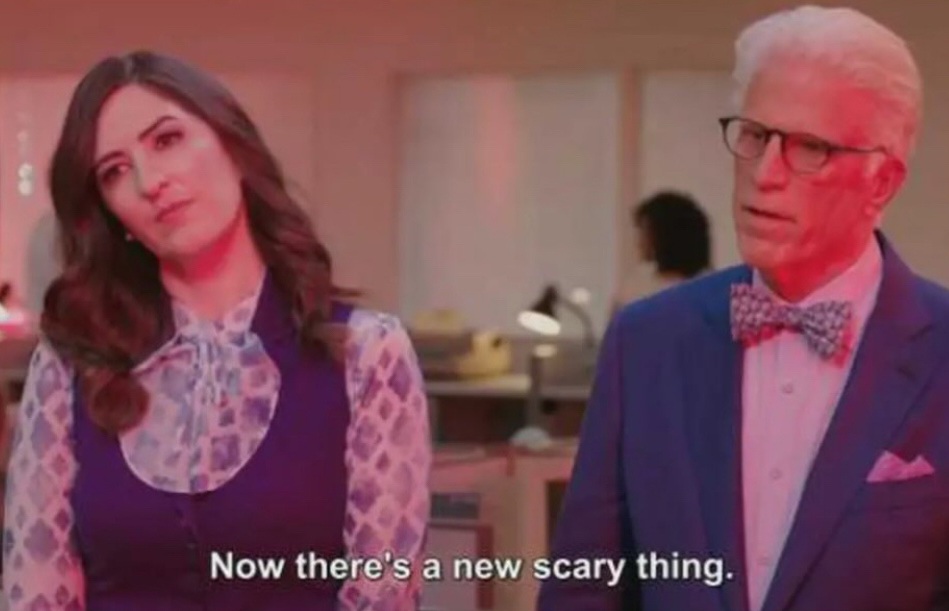
Pictured above: the communities initial reactions to
the parry and shield system in Doom: The Dark Ages
Yesterday’s article was basically a tl;dr for Doom: The Dark Ages in it’s entirety, albeit based on only three levels out of the 22 available. I wisely labeled it more of a vibe check instead of giving it an official preview moniker of course, because I’m not a fucking maniac. More so due to the notion I think the structuralism of previews in their official capacity are almost too restrictive in their approach, and like a bad tutorial, far too exhaustively hand-holdy in the process. The tl;dr of The Dark Ages I put forth was a simple one; the halfway point between 2016 and Eternal, in a move that may end up making no one truly happy in a moment of compromise. Or maybe in a more playful paraphrasement; 2016 walked, so Eternal could run, while Dark Ages ends up getting winded while catching it’s breath and frustratingly trying to keep up.
This scene sprang to mind when conceptualizing the
contrast between the last two Doom games styles of
maneuverability, and then upon a quick second thought,
immediately regretted my abhorrent shortsightedness
in drawing the comparison
I think one of the reasons I’ve found value in the vibe check, almost putting forth the notion of the “game in a nutshell” maybe even at a dangerously early point in gameplay, is that as much as no one really likes to admit it, video games are, distilled to their most basic essence, repetitive motions involving a formula. This leads to the idea of a gameplay loop that’s been iterated to death upon, and one that has proven to work on some level. I’m reminded of the 30 seconds of fun quote hailing from Halo legend, and I don’t ever really let the idea go out of my head for too long because it happens to really fit into the idea that games at their core are really just straight forward, small segments of stupid fun repeated ad infinitum.
Sometimes they even forget to include the fun at launch,
making some games just small segments of stupid 𝖿̶𝗎̶𝗇̶
repeated ad infinitum
Even though I’m comparing ridiculously different games seemingly with broad strokes, I take this moment now in declaring why I feel the vibe check is appropriate for contrasting all games under the sun, accepting the premise of the 30 seconds of fun quote applied widely and without prejudice, from anything ranging between Doom and Animal Crossing. Not only do I find the stress test involved with the vibe check a fun effort in seeing how close my predictions end up being, but strangely enough, Death Stranding really helped to solidify the moment of why trusting my gut was the way to go in deliberating on what an experience was going to be. Just this insanely simple notion of seeing the content for what it truly is, very akin to borrowing a tried and true methodology imbued with the phrase “trust people the first time they let you know who they are”. With Death Stranding, after about five hours of delivering packages, I thought to myself “damn, I’m just going to be ass deep in boxes this whole game, huh?” Many others said “no, you’ve got to give it more of a chance”. I wasn’t so sure I was wrong. Fast forward 200 hours later, and what do you know?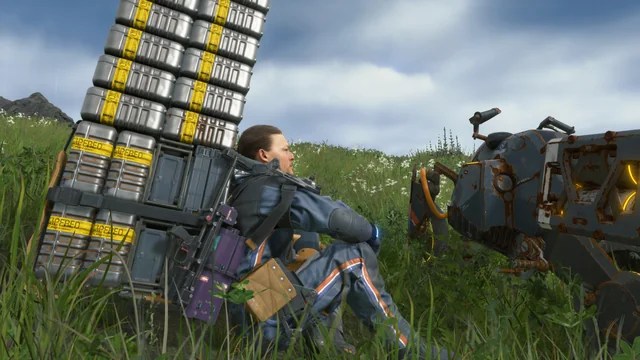
Ass deep in boxes
Luckily, in Doom’s case, the series mission statement tends to be “Rip and Tear, until it is done”. An endearingly brutal sentiment, to be sure, though I think the reason Dark Ages is getting some push back about it’s inherent nature is due to the notion that this time around, instead of ripping and tearing, we are “Shielding and Parrying, until it is done”, which definitely takes some bite out of the canine, in trying to teach this old dog a new trick.
~Pashford
Tag Archives: Captain America
Vibe Checking Hell
Filed under Active Time Event
Behind the Games: Alien Signifiers
In a world that often defies the concepts of what constitutes normalcy, one is then tasked with the notion of approaching the everyday with a paranormal thought process.
Let’s get real spooky with it
Something I think about a lot that maybe doesn’t become more radically apparent to the readers eyes is more about the ideas behind the games themselves then just what the games “have to offer”. I’m sure I’ve stopped to consider before how others view or interpret gaming, though I find it’s always worth sharing just how deeply I’ve dug into the consideration of what those realities entail. I believe this thought has come to mind with my small article involving the Metroid Prime 4 reveal, and my approach in briefly covering “what it is” vs “what it isn’t”, or at the very least in a more paired down exposition of the matter, the information people wanted from the piece (or said trailer the piece was about, more so). I kind of alluded to some of what I’m speaking to right now with my mention of another article involving just what makes a “REAL” Zelda game, in fact a “REAL” Zelda game, and obviously, opinion’s will vary.
Worth it to mention for our younger readers, that
the trailer for Wind Waker on Gamecube, which debuted
more than twenty years ago, had initial push back from
a bunch of “hardcore” fans for not being a “REAL” Zelda game
One word I didn’t use at all in my original decontructionism involved with “The Abstract Limitations of Wisdom”, and it’s address of what entailed the “-ishness” of gaming in general was in reference to “signifiers”, which reappropriates a word from philosophy to better understand gaming through a similar lens, and helps to highlight my points in both frame of reference for how I view games, and the relative value of how others view games, among a myriad of aspects involving the “play” process. For example, with Metroid prime 4, I didn’t feel the need to focus on any lore indicators and or implications about the MP4 trailer, even the name of the planet, let alone the fact that Samus got “psychic abilities” to operate mechanisms within the games context. Some of this does boil down to priorities, as others may be more invested in the world of Metroid more than me, but the relative “signifiers” for what was present seemed on brand with MP4, which was the priority implicit with the presence of the “signifiers”, more so in the general vibe of what people would come to expect within the series defaults, more or less.
More to a specific mention, moments involving a new ability are relevant, yes, like Samus’ new “psychic abilities”. Though relevant, these abilities do represent just another “signifier” so to speak, and brings to light the idea of properties possessing propositions, that familiar which belongs to them, these elements they guarantee as “signifiers” and that one can effectively blend or utilize appropriately. Whether the utilization is through fantasy, sci-fi, or a hybridization process thereafter, the “signifiers” embody the rationalization of the entity, and thusly dictated and vindicated through the property possession proposition of said entity to predicated the “signifier”. One quick example that springs to me in reminding me of some of the “high” tech stuff that might pass off as a hybridization process thereafter (I.E. MAGIC) for such in the gaming realm is Metal Gear Solid, which more or less kind of comes off as purely magical in some respect, but still as a series, has a very strong identity, with effective “signifiers” for what gives Metal Gear Solid it’s “-ishness”, so to speak.
Pictured: “the unseen”, aka, nanomachines, son
With all that in focus, but shifting perspective a little bit, I think reassessing the priorities of the collective represents a good relative observation as well, as gaming possesses several interpretations, depending on who you speak to. I think, in maybe the most reductionist of approaches, reducing gaming to a consumer product…which it is, if we take away the magic of marketing and the beautifully blinding effects of nostalgia for just a moment, then we beging to see the justification process involving the relatively straight forward yet bizarrely abstract evaluation methodology of what the game worthy or unworthy, as it were
A set of signifiers, as it were, which sometimes entails
Captain’s America’s buttcheeks
Within an even greater narrowing of this perspective, or to help dismistify the trascendence process of worth to a zero sum total, Nintendo is essentially selling the player on this new game with signifiers, and in that context, you have to look at Samus’s new suit, the new abilities, and even in more obtuse ways, see “the unseeable”, to deduce whether or not both what you have been shown and from a marketing standpoint of excitement, what has not been shown, in order to justify to yourself whether or not these new signifiers represent a successful rationalization process to spend sixty dollars. I think to many, that would almost be a spoiled deconstructionism of what has occurred, with so many excitable hobbyists defending brand names or delusional fanboys already sold on the name Metroid Prime through a process of self-identifying through brand name and consumer product alone, the unseen of the trailer is the blind loyalism that follows a branding of signifiers that concludes an already spent sixty dollars, outside of further context.
Basically what anyone thinks when they start reading any philosophy
I had a lot more to say, which would have continued to dive into the notions of the metaphysical realities that follow suit in the observance of the nature of gaming and how those abstractions further and perhaps even more importantly cement the notion of valuable signifiers within the realm of gaming and the unseen, as it were, but we’ll have to leave it there for now. I am left with the notion that I have long agreed, as an aside, with the old observance that gaming is a business that art sometimes escapes through, though that’s another conversation upon itself as well, and yet one more point of interest that will also have to wait patiently in the wings until it’s more timely debut is to be center stage within the theatrics of the gaming world.
~Pashford
Filed under Active Time Event
 Active Time Event