Tag Archives: Atari

30 Seconds of Fun

I’ve been talking about nostalgia recently, and it’s easy to understand why. When your hobby finally reaches more than 50+ years of relevant history, there is a lot to look back at all of the stunning quality involved with a respectful fondness.

And sometimes not

With that in mind, once a year, I usually get a hankering to go back and play some old, old…old old school video games, and the hankering to play Yars’ Revenge hath returned. I decided to download Atari Flashback Classics Vol.1 to quell the desire, but also because I kind of needed something a bit short and sweet due to time constraints to discuss, and several decade old video games fit the bill.


Sic Parvis Magna

The classics collection series has been around in some form or another for awhile now, seeing both physical and digital releases over many years. They also had a run of plug-and-play related mini consoles that stored the dozens of games involved with any single iteration just to give it that real old school feel, Atari 2600 controllers included and all. This was well before Nintendo wanted in on the slice of the mini console retro pie with the release of the NES and SNES mini respectively. My point: in both their original forms and their re-released iterations, all of these games have been around for a hot minute.


Oozing forth from the halcyon era of the primordial soup

So one has a lot of games to choose from, even if many of them are extraordinarily simplistic and straight forward, and I cannot heavily emphasize enough of just how basic the games we are dealing with are. With Pong having been released all the way back in 72′ and working from there, to say these games are antiquated is an understatement. The severe technological limitations of the time demanded that the experiences were ridiculously compact, so often times a game would involve sometimes only a single screen encompassing the totality of all gameplay involved.


Which did save a lot of time on gathering screenshots, mind you

You have to have a sense of humor about it, cause the whole thing is fucking silly when you really think about it for longer than two seconds. Don’t get me wrong: I do genuinely appreciate the gameplay involved with these classics, and the history that they represent, but you take a step back for a second and realize you’re dictating on a bunch of blocks on a screen with a high pitched buzzing sound from time to time and quantifying the creative endeavor or semantics of the game design therein. This write up will probably take more of your time than the average amount you’d spend playing any one of these games, in all of their adorable succinctness.


Behold! Basically all of the gameplay of Black Widow in a single pic!

Much to that point, there is a relevant quote I’m re-appropriating from a game designer named Jaime Griesemer, who worked on Halo 1 and 2 for Bungie back in the day. He famously described the process of designing a game as trying to nail that “30 seconds of fun”, massively paraphrase of course, going on to describe an average encounter in the Halo games he worked on. He would go on to point out that you can have great graphics and a cool story, but if you don’t nail that 30 seconds, you don’t have a game. (apologies for the lack of linked source; it happened, trust me.) Based on the caliber of design for both Halo titles in question, I would most certainly be inclined to agree. Retrofitting and applying that quotation within consideration to these old school Atari titles, the games represent such a distilled sense of concentrated gaming goodness, coupled with the limitations of the time, and you really are seeing that quote live up to it’s essence in real time, as any of these games really are that 30 seconds of fun and nothing else.
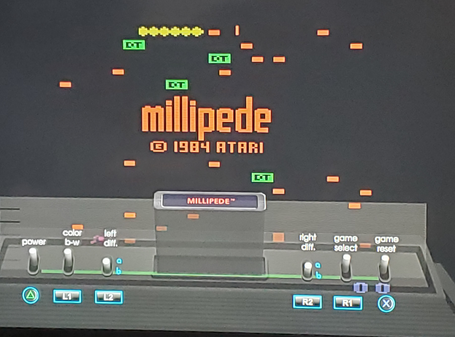

The replaybility on Millipede really has legs

And that’s perfectly alright, mind you, as these games had no frame of reference to work with, as their mission statement was to become the frame of reference for future generations to be inspired by. The onus back then was on giants like Atari to create the context for what would become the groundwork for the very foundation of gaming itself. Accomplishing that by spending time developing a title in a couple of months with almost no staff, a couple kilobytes of memory, and 30 seconds of fun to play around with, and you are left somewhere between shock and awe as you laugh at the absurdity of this very notion having spawned a multi-billion dollar industry that helped to make gamers of us all.


Yars’ Revenge: a real work of art

As is the case with a lot of my writing, I always have a billion ideas at the ready and only about 10 minutes to to do anything with them all. I’ll leave you with the reminder that Yars’ Revenge is awesome, and that in a stroke of ridiculous absurdity, a follow up sequel more than 40 years later (!) called Yars Rising, which is taking the form of a Metroidvania, is coming out for the Switch in a mere 23 days. And how!

~Pashford

Leave a comment

Filed under Uncategorized

Encyclopedia Muranica: Phoning It In

Hey Gamers,

As some of you may have noticed, I was quite quiet throughout the majority of April, making only small mention of myself by way of Mario Kart, and my highly troubled misadventures on Star Road.

And The Rocket Men Who Helped To Cause Them

And The Rocket Men Who Helped To Cause Them

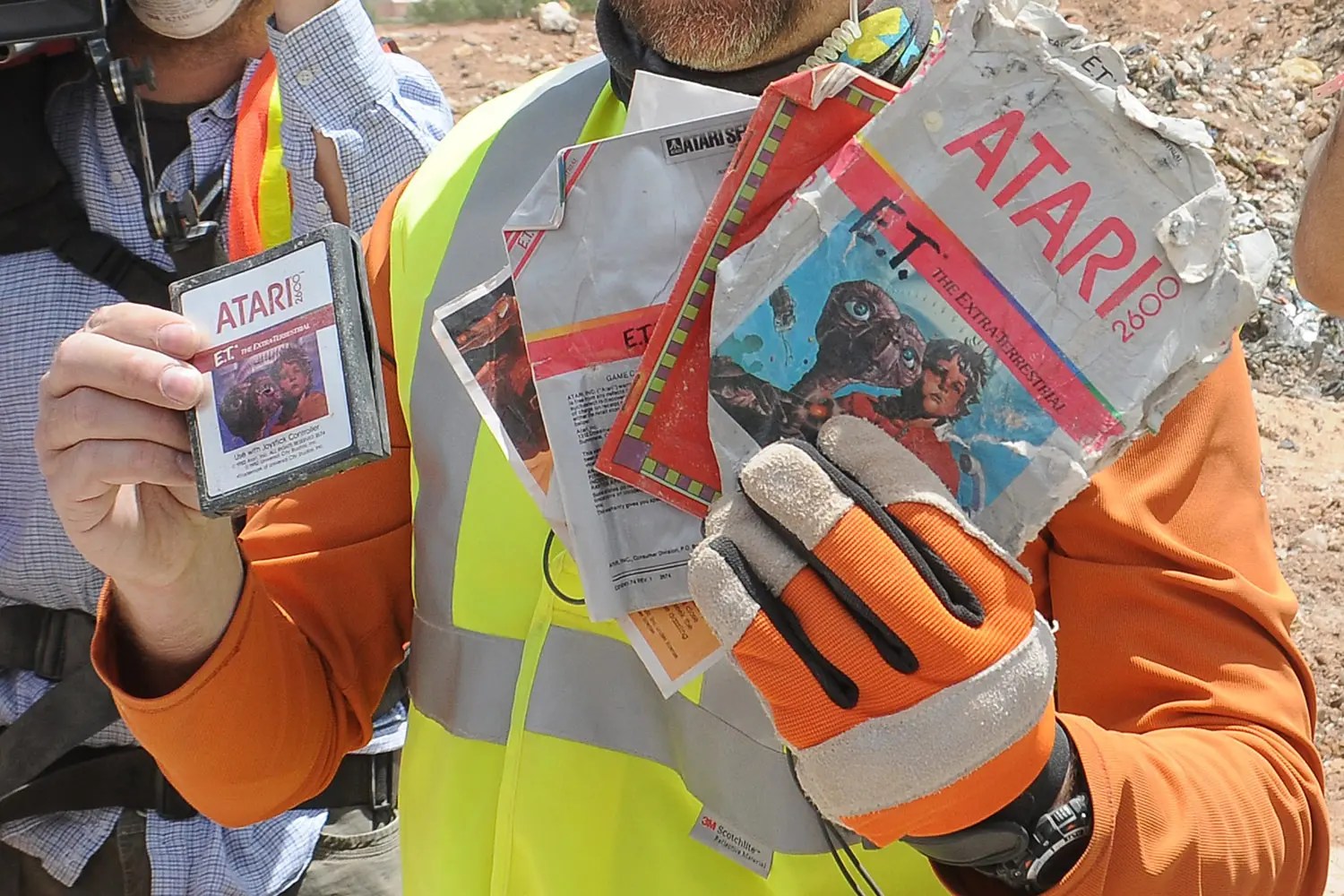
I would bother explaining why I was without voice during the past month, but I think I barely understand it myself, so I’ll save you the time. Rest assured, my mind has still been predictably fixated on video games, and the odd happenings surrounding them. One of the more stand out oddities of the past couple weeks, came in the unexpected form of baring witness to a painful past being uncovered, and a long standing myth finally being laid to rest, once and for all.

Not This One

Not This One


Wrong Again

Wrong Again


Already Figured This Out

Already Figured This Out

Already Solved

No Longer A Mystery


Dude, No

Dude, No

Okay, This One Isn't Even Remotely Related

Okay, This One Isn’t Even Remotely Related

That's The One

That’s The One!

Though, for anyone behind the gaming times on the rest of the myths I farcically mentioned, they go as follows:

1. Couldn’t Get It
2. Didn’t Exist
3. Complete Joke
4. Absolutely Possible
5. Totally Happened
6. Turns Out His Name Is C.G.B Spender
7. True, Apparently

I probably should have waited to give away the ending to the E.T myth, but it’s been pretty big news, even outside of regular gaming circles, so the chances are you’ve heard about it by now.

If not, SPOILERS.

If you hadn’t guessed already, I have been following the whole affair with some exuberance. I find gaming culture, by and large, fascinating. Needless to say, one of the longest standing and most noteworthy myths of all time finally being proven as true is equal parts amazing as it is astounding. Many believed the facts surrounding this supposed fiction to be entirely funny, to the point of hyperbolic jest of the game’s regularly observed quality. Though, at least since I’ve been making my rounds on the gaming circuit, the joke became more of a possible reality than a ridiculous fantasy.

Cementing once and for all, that E.T was indeed cemented over.

Belive Me, It Really Does Make Sense

Belive Me, It Really Does Make Sense

I wasn’t there, of course, but that didn’t stop me from feeling completely involved. The event was covered by Wired.com, with my friend Chris Kohler reporting on the whole thing. I was lucky enough to get the pictures front and center, moment to moment, in all of their hilariously surrealistic glory. You wouldn’t think people standing around in a landfill looking for something so hated it was buried out of financial rage three decades ago would be so fun, but it totally was. While the mystery surrounding the event is now muted, with the fiction becoming the reality, it does prove once and for all how toxic this game was really considered. As many before me have pointed out, E.T represented the turning point for video games in the early 80’s, with many citing it’s failings as one of the first of many that contributed to the game crash of 1983.

This discovery of the games in the Alamogordo landfill solidifies two facts:

1.E.T was figurative garbage
2.E.T was literal garbage

Not many games can brag about failing on such levels that E.T has, with some truly Herculean feats of failure for E.T to champion, and a legacy that will continue to haunt all of those involved.

At least, I thought so initially, not really giving the topic a more open approach and careful consideration. It’s been well documented that E.T is awful, truly and utterly, with few peers in it’s respective field to challenge the ultimate shittiness it absolutely represents. However, in it’s complete lack of quality, E.T ends up doing what few games ever achieve, and that’s become a cultural phenomena, one that super-cedes or at least completely obscures what the game actually accomplishes.

Which is nothing, at least, from a design standpoint.

I Mean, This Is Seriously 50% Of The Game

I Mean, This Is Seriously 50% Of The Game

I’m frightened to think that may in fact be a conservative estimate of the time spent in holes in E.T.

While in essence, there is no successful design to speak of in E.T, and it’s design only by proxy relates to my point about the game in some manner achieving success, I will take a second to point out the true absurdity of E.T as a game. Though I had painstakingly played the game several times before, it wasn’t until I replayed it in response to this recent unearthing did I realize the absurd truth of the matter. When I mentioned that at least 50% of the game is spent in holes in E.T, the more maddening aspect of E.T is that winning in the game looks exactly like losing in the game, with the lines of reality blurring intensely as a result.

The Whole Game

The Whole Game

The object of E.T, in a sense, is to fall into holes (to reclaim parts for E.T’s phone…you know, for home). Since the game is always randomized, you must fall into a large variety of holes to find said parts, which means no matter what, you must fall into holes, that may or may not be relevant to your phoning needs. With this in mind, I reinject the madness previously mentioned, as any degree of success or lack there of, looks exactly the same. Winning looks like falling into holes. Losing looks like falling into holes. Sometimes, you don’t fall into holes. Is this winning or losing? Both or neither, maybe.

Either way…

Pure Insanity That Will Leave You Paralyzed

Pure Insanity That Will Leave You Paralyzed

I don’t think enough people play E.T for long enough to realize they’re in a hole to begin with, and that more await there clumsy/effective means of play. I forced myself to see the “win? screen”, as I wasn’t entirely sure if I had done so previously. This screen is as confusing as the journey to get to it, and only reintroduces you to the very same idea immediately after.

You must become the hole, as the holes becomes you.

Like most Atari games, there really is no end. Even the manual reminds you of your only two bleak options in ending your experience:

1.You Die
2.You Stop

Again, the distinctions between success and failure are complete semantic, really only acting as a reminder of your own grasp on reality, and the existential concepts you have to deal with before you even turn off your Atari 2600. I’m not sure if I’ve sub-consciously associated the same quality with the movie after so much time with the game, though I will mention I haven’t sat down to watch the movie since perhaps my first session of E.T on the 2600. Were there holes in the film? There must have been, though none quite as confounding as the ones the game possesses, this I am certain of. I definitely don’t recall during the course of E.T (the film) that I was strangulated with intense ideas involving existentialism, though my hunger for Reece’s pieces may have entirely obscured the truth of the matter.

The Truth Perhaps Just Hiding In Plain Sight

With The Truth Of The Matter Sometimes Staring You Right In The Face

It all seems so obvious now.

Digressing waaaaay back to my initial point that it wasn’t the design of E.T, in it’s oddly present yet not existing glory that was relevant, but ther mere essence of what E.T has become to the masses. This is a game that achieved so much of nothing, that it ended up creating something. A sub-culture, a myriad of followers, and even one of the greatest myths of our gaming day. Through it’s nothingness, E.T achieved somethingness, which not even excellent games can brag about. Even in my musings and honesty that the game feels like no game at all, I’ve spent hours in the past week playing, thinking, writing and speculating about the sheer levels of nothingness involved.

Nothing

Well, Even Nothing Is Something

And as mentioned, nothing in this case truly becoming something.

With my digression fully intact, I want to quote the creator of the game, Howard Scott Warshaw, who was more poignant in his opinion on the whole excavation than perhaps he even meant to be:

“When I first made this game, the whole point was about entertaining people…like this (excavation) right now behind me, and it’s still entertaining people, only now it’s not legend it’s fact.”

Which was a fascinating point, as mentioned one that has interest beyond it’s initial premise. One I’ve also heard posed before, by none other than the director of Troll 2.

Yes, I did just mention Troll 2, and I know what you’re thinking.

Oh My God

Oh My God

While I won’t even bother digging up the exact quote, the director of Troll 2 (Claudio Fragasso) pointed out that his efforts in making Troll 2 had a very simple goal, entertaining. Through, what I’m guessing was sheer willpower or tremendous ignorance, no one knew what they were actually creating when they were helping to make Troll 2, though it eventually came to be what we know it to be today. Troll 2 is much like E.T in this regard, who’s creator (Warshaw) had one simply desire: to entertain, despite any and all lack of quality.

Through a magnificent series of events that truly blur the lines of realities, we end up having a nothing that became something, and a loss that became a win. I’ve theorized before about the nature of “success”, only to conclude how success is all relative, and how one can never truly anticipate what “success” may even entail, till time has come to unearth the truth.

After my intense enjoyment of these events, and my utter disdain for E.T as a game, one last truth came into focus. E.T achieved being more than just a game, despite many arguing there was no game to begin with.

~Pashford

Leave a comment

Filed under Encyclopedia Muranica, Uncategorized